
Why I built Pythia
Pythia is the investment analysis system I built for myself because I wanted a better way to think.
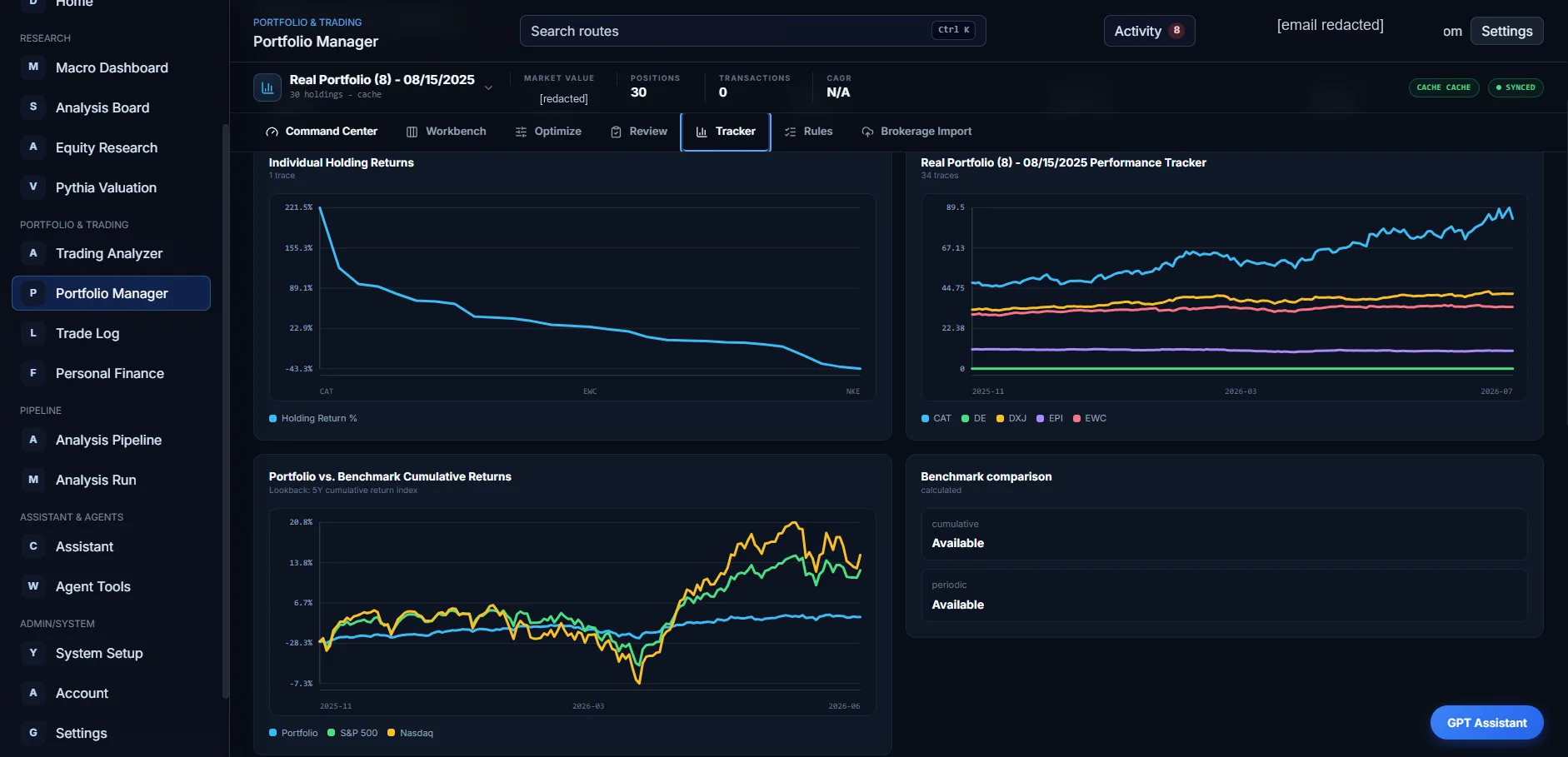
It is the portfolio manager I wanted to become, rebuilt as software I can actually use.
I first began investing when I was thirteen years old with my first brokerage account on Stockpile, where every buy or sell required approval from my father. I, of course, had no idea what investing was, and I just bought and sold based on the news like everyone starts off doing.
My initial draw to investing was more akin to a gambler discovering a casino for the first time than a Christian finding a Bible. I really liked the idea of sitting at home while watching charts and making money; it seemed very real to my young mind.
Thankfully, my father held the keys to trade approval, and didn't let me act like a WSB alum during those days, so the bad habits I would have formed were ultimately rejected by my father's checks. Now, that is not at all to say my father is some master investor; however, he understood the fundamental principle of going long on great companies. He has little finesse past that, but that method is one of the soundest through time.
He rejected my dumb instinct-based trades and only let me make investments he himself would have been willing to make. Although I was not really in control, the semblance of being in control was enough to ignite a passion in me. I wanted to become a portfolio manager.
Over time, my perspective on investing has shifted radically. Rather than seeing the market as a casino of blinking charts, I've begun to see investing as one of the more practical ways to create long-term financial security and stability, especially now given the possibility that many non-physical skills may lose value to AI in ways they otherwise would not have in a non-AI age.
The compound interest graph that stuck
The most pivotal shift for me came in economics class in high school.
That was the first time I saw a compound interest graph that actually stuck with me. The example was simple: one investor puts away $5,000 a year from age 25 to 35 and then never contributes another dollar. Another investor starts later and puts away $5,000 a year from age 35 to 65. You can open the compound interest model directly.
The person who started earlier invested far less money in total, but because the capital had more time to compound, they could still end up with more money by retirement.
That triggered a fundamental shift in my perspective. There was little need to ever "hit big", given such financial planning and implementation at such an early age. I could make the average American salary and, given no tragedy, be a millionaire by 50.
From that point, I began to bite on the ideas and hop on the trains of things like ETF and index investing. I realized consistent returns north of 10% with quantitatively managed risk profiles are good, especially considering the mindlessness that accompanies such investing. These investors do not watch the market all day; most of the time, they cannot even tell you the value of their portfolio. For me, this is not active enough and not only leaves returns on the table, but opens investors up to potential additional risk. I, for example, have a portfolio that is objectively less risky than the S&P 500 across multiple quantitative methods. The train has become too full in my opinion, and I think managed portfolios will outperform the markets over the next 5 years; but regardless, I still see the value in index investing.
I wanted to become an investor who essentially had the chill mindset of an index investor, but could tell you things like what the Sharpe ratio or beta of their portfolio was. I did not know what that math was yet, or even what the terms themselves meant, but I had read enough to know these metrics existed and were important to watch. I knew that the company itself, in some regards, was only part of the picture when it came to a good portfolio. Underlying fundamentals existed that could make "good" companies bad investments and "boring" companies great ones.
This, of course, led me to start considering my future: how would I fund the account and consistently deposit?
If all I had to do was secure a job that let me put away $5,000 a year from 25 to 65, and if that money could compound intelligently over time, then I did not need to become a Wall Street portfolio manager to become financially secure. I just needed financial literacy, income, discipline, and time.
This led me to decide the compound effect of going to school for finance and working in finance would help me build the financial literacy necessary to become the investor I wanted to be, while also making enough salary-wise to save and still live life.
In hindsight, I probably should have gone down the data or computer science route. I was always more interested in building tools, analyzing systems, and creating my own workflows than in the traditional finance recruiting game. I, as a self-proclaimed nerd, am lacking in the traits/skills which are found in most successful finance professionals.
My collegiate finance experience was mostly reinforcement learning and tangent discovery. That's not to say I didn't like or value school; it's just to say a lot of what "should" have been novel was stuff I was already doing professionally. By sophomore year, I was managing real pro formas and handling financial and managerial accounting work for my mom's construction owner-representation company. A lot of what I learned in investment analysis were concepts I had either already learned independently or had started implementing while building Pythia.
I did well in school. I graduated magna cum laude. But not well enough, or not positioned well enough, to make my resume stick out and break into high finance. I thought genuine interest and determined effort would be enough: that building things that showed clear interest in the subject, doing well academically, and working hard would speak for itself.
It does not.
To any current finance majors, I am here to tell you: join the clubs, be active in them, build a network, and do it with intent. Take it from a magna cum laude graduate with 200+ applications and very few meaningful replies; no network to lean on = island by yourself. Some of you will be entrepreneurs and that will be fine, most of us won't; so take advantage of the networking opportunities available to you in college.
You need people
That is not an AI thing. That is not even purely a finance thing. That is a career prospects thing. You need people. You need visible involvement. You need proof that you can operate in the social machinery of whatever industry you are trying to enter. I was too nerdy for the traditional finance path but too undecided to fully commit to the technical path early enough.
I am now working in an accounting role within a developer and hospitality group. Although I am not where thirteen-year-old me thought I would be, I look back and realize two very important things.
First, the cause of my grief was believing I had determinant outputs from subjective inputs. What even is "hard work" in relative terms? Did I work harder and perform better than a large portion of my peers? Maybe. But did I work harder, network better, position myself better, and perform better than the students who actually landed the banking, investment firm, and asset management roles? No.
Second, the whole reason I got into finance was to build financial literacy. The original idea was that if I became financially literate, I could choose almost any career path and still create financial security and stability later in life.
I am essentially still on plan, I just won't be getting portfolio management experience professionally. That's why I built Pythia, to supplement the experience I won't be getting in the field. That's why I will continue to build it, so that I can eventually surpass the literacy I would have attained in the field.
Pythia is my practical application of everything I have learned about investing, financial modeling, business analysis, data, automation, and portfolio monitoring. It is the investment analysis system I built for myself because I am LAZY. I simply cannot imagine running the analysis pipeline myself over hundreds of stocks; it would take too long and the data would be outdated by the time I had enough to run a comp analysis of the reports.
It is my attempt to automate and improve my analysis flow: financial statement review, ratios, risk metrics, earnings analysis, valuation work, qualitative research, portfolio monitoring, and saved commentary. It is the tool I wish I had when I first realized that investing was not supposed to be a casino.
The point is simple: a few percentage points matter. A few years matter. Process matters.
Pythia is my attempt to make that process easier and more determinant for myself.
Not to magically predict the market or guarantee some fantasy return. But to give myself a better shot at turning the basic 8% compound-interest lesson that first changed my perspective into something closer to a 12-15% long-term aspirational outcome through better analysis, fewer emotional decisions, and a more disciplined portfolio process.
There will be no new interactive model here, as I believe the compound interest model from the intro blog is especially relevant to this blog.