Why You Should Make Your Own Version
A practical essay about using AI to build around your own interests, not by copying Pythia directly, but by turning a serious personal workflow into software.
The point is not to copy the app. The point is to copy the loop.
I do not think everyone should build Pythia.
I do think more people should build their own version of it.
Not a clone. Not a finance dashboard with a different logo. Not a weekend demo that looks good for ten minutes and then collapses the first time someone asks it to save data.
By "your own version," I mean a serious tool built around a domain you actually care about. Something you already think about more than most people. Something with enough depth that the weak parts keep bothering you after the first version works.
The point is not to copy the app. The point is to copy the loop.
Start With The Problem That Keeps Reappearing
The best AI-assisted projects do not start with "what can I make quickly?"
They start with a problem that keeps showing up.
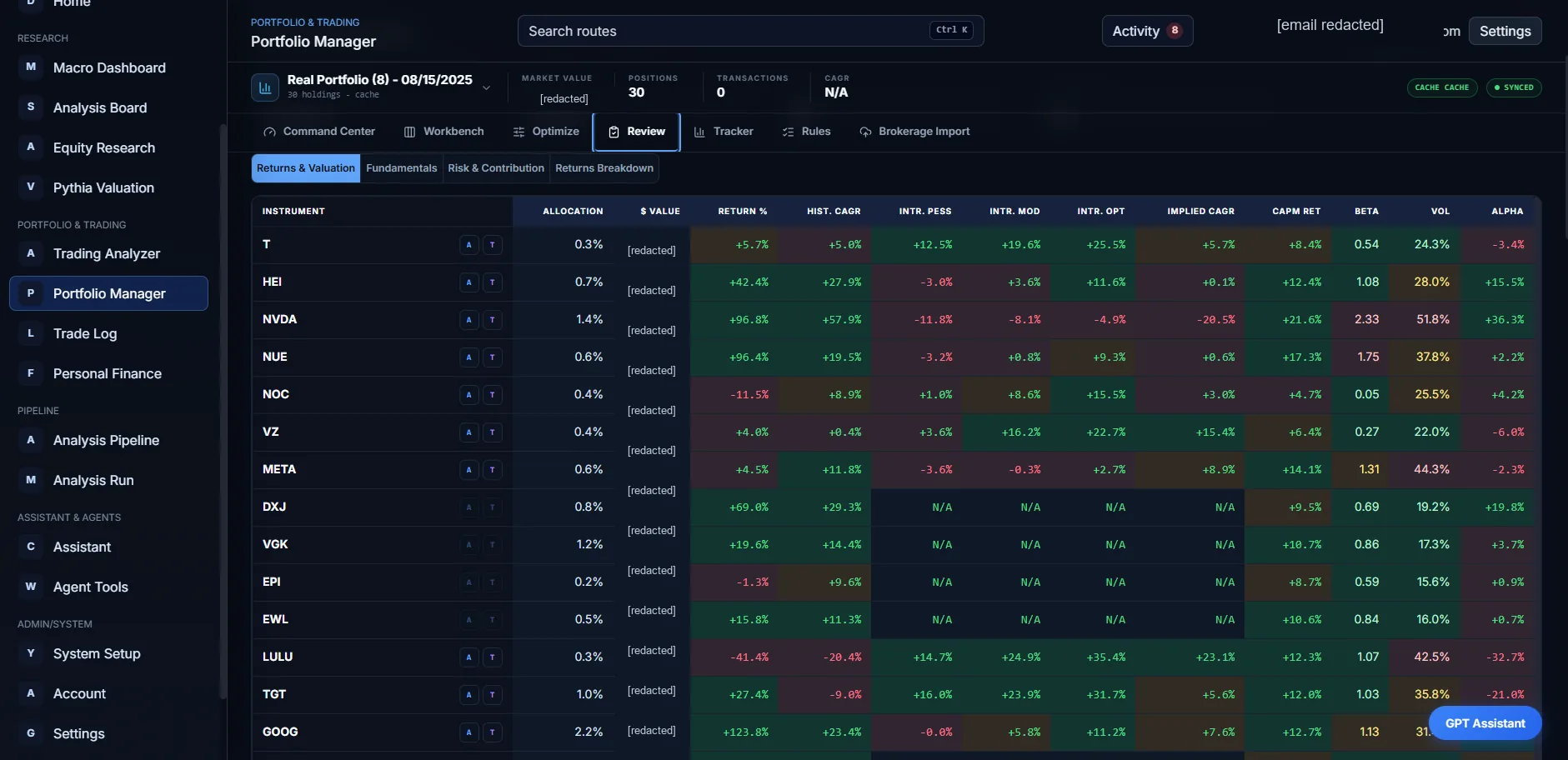
For me, that was investment research. I wanted to connect valuation, financial statements, earnings, macro context, saved analysis, portfolio review, and AI-assisted commentary into one workflow. I did not start with a clean product roadmap. I started with friction.
Too many tabs. Too much repeated work. Too many numbers that had to be recomputed. Too much commentary that was not tied back to durable evidence. Too many places where an investment decision could become a vague memory instead of something I could inspect later.
That mattered because I cared about the subject. If I had picked a random app idea because it sounded marketable, I probably would have quit when the first ugly part showed up.
This is why your own version has to come from a domain you already respect.
If you care about construction, build around bids, change orders, site photos, schedules, and cost history. If you care about medicine, build around study notes, symptoms, literature review, and decision support that stays inside responsible boundaries. If you care about sports, build around film, player development, lineup decisions, and training data. If you care about music, build around practice logs, references, arrangements, and feedback.
The exact domain matters less than whether you care enough to keep working when the easy version stops being useful.
The Demo Is Not The System
A demo has limited use. A system is the working version of the demo.
That distinction matters more now because AI can help almost anyone make something that looks like software. A landing page is easier. A dashboard is easier. A chatbot is easier. A prototype is easier.
That is useful, but a demo is not the same as a system that survives use.
The system has to store state. It has to reload. It has to know what it is allowed to claim. It has to keep private things private. It has to fail in a way that does not destroy trust. It has to make the important parts inspectable.
Pythia forced me into that lesson over and over again.
The app needed routes, callbacks, persistent state, Supabase tables, authentication, saved analysis, background runs, public and private boundaries, tests, deploy scripts, launch-safe assets, and enough documentation that I could come back later and understand what the hell I had built.
That is where the learning happened.
Not in the first generated file. In the part where the thing had to become durable.
AI Needs Substrate
The lazy version of AI building is asking a model to make something from a vague desire and then being surprised when the output is vague too.
The better version is giving the AI a job, constraints, and substrate.
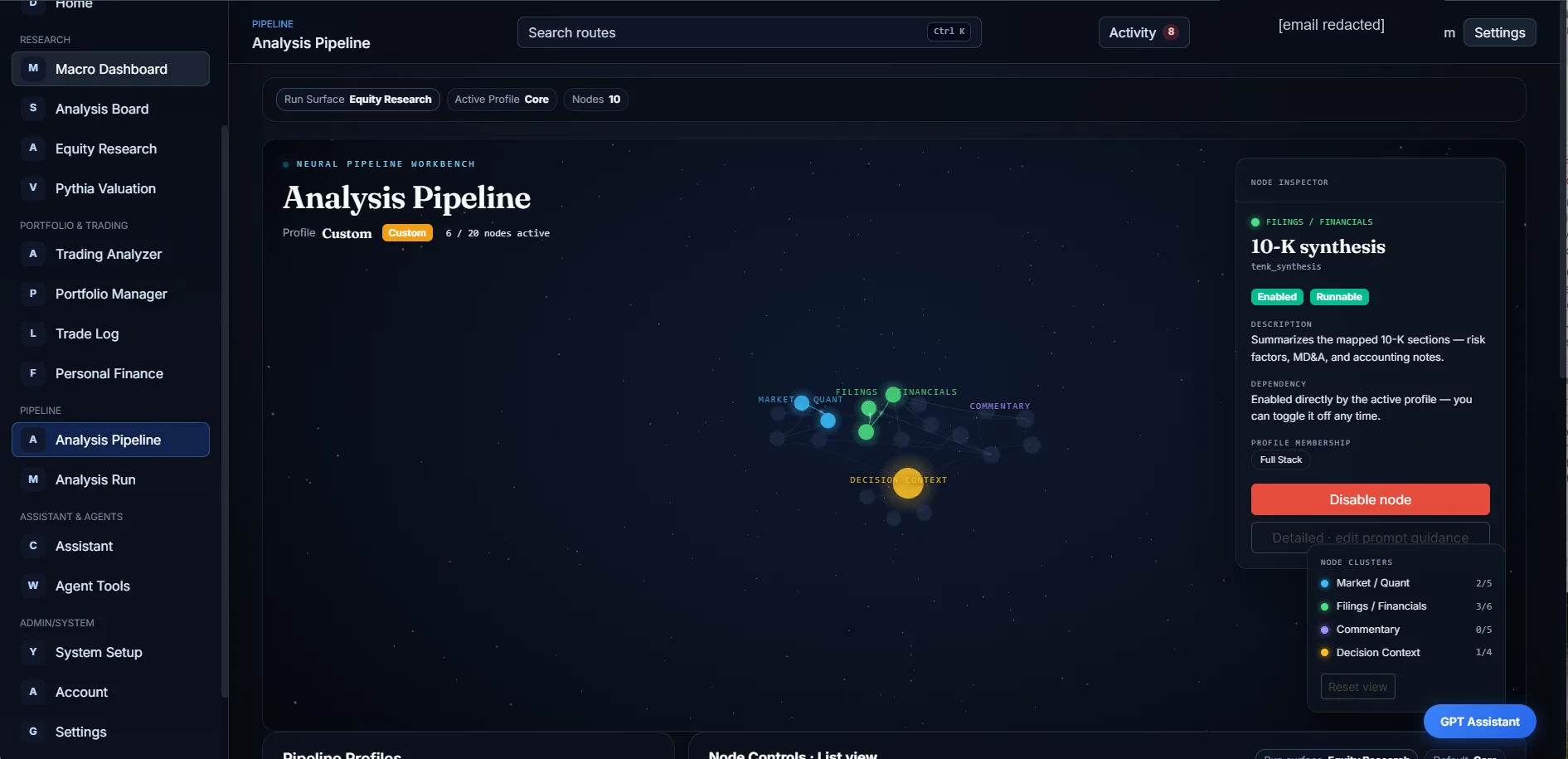
Substrate means the model is not guessing what matters. It has specs. It has docs. It has tables. It has examples. It has current app state. It has the exact workflow you are trying to improve. It has enough context to synthesize instead of hallucinate.
This is the main lesson Pythia taught me about AI:
The AI layer should synthesize. It should not be the source of truth.
In Pythia, deterministic services own the numbers. The valuation logic, saved analysis rows, portfolio state, macro context, and source notes have to exist before the model gets to explain anything. The LLM can add nuance, connect evidence, and draft commentary. It should not invent the valuation, pretend stale data is current, or decide that a trade is good because the sentence sounds confident.
That applies outside finance too.
If you are building a tool for your own field, do not let AI become an everyman. Give it the raw material that a serious person in that field would use. Make it respond inside the rules of the workflow.
The blunt version: stop being lazy and tell it what you actually desire.
Your Domain Is The Advantage
People sometimes talk about AI like the model is the whole advantage.
I do not think that is right.
The advantage is knowing what good output should look like in the first place.
If you understand the domain, you can tell when the generated work is shallow. You can tell when the workflow is fake. You can tell when the interface is pretty but useless. You can tell when a feature exists because it sounded impressive, not because it makes the job easier.
That is why building around your own interests is powerful.
You already have taste in that area, even if you do not call it taste. You know what annoys you. You know what gets repeated. You know where the existing tools feel wrong. You know what a beginner would miss and what an experienced person would check.
AI can help you turn that judgment into software faster than before.
It does not replace the judgment.
Let The Project Make You Better
The best reason to build your own version is not that it might become a company. It might, or it might not. The better reason is that the project will force you to become more serious about the thing you already claim to care about.
Pythia changed how I invest because it made my own thinking harder to hide from. It made me care more about process, reproducibility, portfolio role, saved assumptions, and what changed after the original thesis. It made me less interested in random action and more interested in whether the decision could survive review.
It also made me better technically because the app kept demanding skills I did not have yet.
I did not learn databases because I wanted to memorize database concepts. I learned them because the app needed durable state. I did not learn testing because it sounded fun. I learned it because broken investment analysis is worse than no analysis. I did not learn deployment because I wanted another hobby. I learned it because a tool that only works on my machine has a very short ceiling.
That is the gift of building around a real workflow.
The project keeps grading you.
Make The Work Inspectable
If you build your own version, document the work.
Not because documentation is decorative. Because proof matters.
Show the timeline. Show the architecture. Show the decisions. Show the bad assumptions you had to unwind. Show the screenshots. Show the tests. Show what version one could not do and what version ten can do now.
That is what makes the project legible to other people.
It is also what makes it useful to your future self.
This is part of why I am making Pythia public. The public layer is not supposed to be a brochure. It is supposed to be a ledger. Blog posts, build notes, diagrams, case studies, and launch-safe artifacts make the work inspectable instead of asking people to trust a vague claim that I "built an AI finance app."
That is the standard I would copy.
Do not just build the thing. Build the evidence around the thing.
What I Would Tell Someone Starting
Pick one workflow, not a giant vision.
Write down how it works today. Write down what is annoying. Write down what good output would look like. Write down what the tool is not allowed to claim. Then build the smallest version that helps you do the workflow better.
Use it.
When it breaks, do not immediately start a new idea. Fix the reason it broke. When the output feels shallow, add better substrate. When the UI feels fake, make it match the real task. When the data model starts fighting you, slow down and redesign it.
That is the loop.
Build, use, inspect, improve, document.
Most people will stop at the demo. That is fine. A demo can still teach you something.
But if you stay with it long enough for the thing to become a system, the project starts doing something different. It becomes evidence that you can own a problem.
That is what Pythia has been for me.
The app is not evidence that I know everything. It is evidence that I can stay with a problem.
That is the part worth copying.
Claim Hygiene
This post is about AI-assisted learning and project building. It does not claim that AI removes the need for domain knowledge, testing, judgment, privacy review, or responsible human oversight. It also does not claim that every personal project should become a company or that building with AI guarantees career, financial, or product success.
Supporting visuals