Why I'm Making Pythia Public
A personal note on making Pythia public for recruiters, community, accountability, deployment consistency, and a more grounded relationship with AI.
Use AI to improve the quality of what you already do.
My name is Kristian Ortega. I am a 23-year-old born and raised in South Florida. I have a BBA in Finance from FAU and am currently working as an accountant / Information Systems Engineer-Manager at a development firm in Miami, FL. I am a nerd who doesn't do much but code this app, work, work out, or hang out with my girlfriend. Pythia is my investment suite application, which I have been building for about 2 years now. It is hundreds of iterations built upon one another and my magnum opus of implementing the things I learned in school.
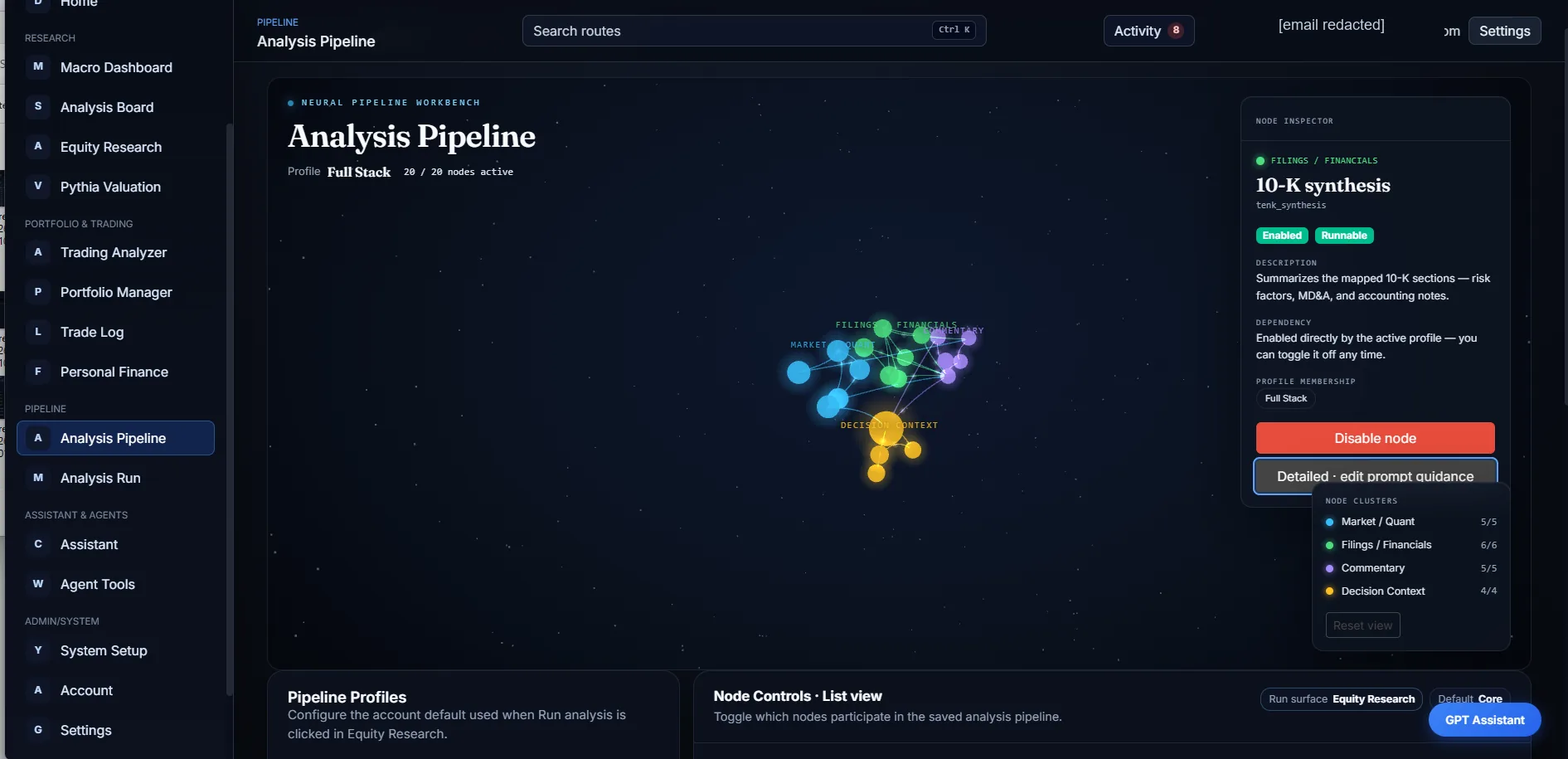
To be completely frank, the biggest reason I am making Pythia public is to show recruiters and potential colleagues what I have built because I believe it demonstrates I have a deep passion for investing. You are currently on the public-facing shell. You do not have actual access to the app here, but the goal of these pages is to make you want to have an account. Although you cannot do actions here, you can get a clear picture of what you can do with an account. For a clear preface, this is a research app, and I will not be charging for use. In addition, LLM use is done through personal API keys that you set. The gate to an account is essentially this: being someone I want to impress, or someone I want in the community.
Now that the self-serving stuff is out of the way, there are better reasons I am making this public. In order of significance to me:
-
I want to build a community of investors that use this app and eventually help me build it. The goal is to make something like a financial advisor / Bloomberg Terminal / investment discussion center. As of now, I have my father, stepfather, brother, and some friends using the app. As one person with this massive vision, there's no real way for me to do this myself without the whole app simply being a confirmation-bias investment tool (aka bullshit). I need a community to disrupt cognitive bias.
-
Things like this blog, the case study, etc., will allow me to have clear trackability and traceability of results and the frame of thinking/mindset that led me to make decisions. In ten years, I want to have built upon my investment capability such that I look back at year one's blogs as novice talk and that year's portfolio performance as subpar.
-
The app being deployed through a VM and website was the easiest way I found for all users to always be on the same app version. There are changes deployed every day some weeks, so this was necessary or else users would have to have Git competency to stay on the same version.
-
There is massive delusion regarding AI capability and significance in all circles of the world. You see it in boomers thinking they have no need to learn it, as they will be aged out of competition or into retirement soon; young kids who do not want to interact with it, as they simply see it as the devil which stole or will steal their dreams and life's purpose; and CEOs thinking there will be no need for middle management, and that they will instead manage a fleet of manager agents. I can go on and on about the frames of mind that are just so clearly misinformed and come from people who have not interacted with AI enough.
To not turn this point into a TED Talk, I'll keep it simple here. AI is useful in the workplace and for learning/applying concepts. Empirically, the data does not necessarily reflect that it makes us more efficient. A 2025 METR study showed that experienced open-source developers using early-2025 AI tools took 19% longer to complete issues, despite expecting AI to make them 24% faster.
Studies like these, however, can miss a very real effect: while output may not be increasing, quality often is. My favorite podcast to listen to right now is Dwarkesh Patel; I can think of multiple scientists he's had on who say the same thing: "While I am not publishing more papers, I am publishing papers of greater quality." I do not remember who it was, but I remember he said that where he used to write or explain the data in inline text because it was quicker, he now dumps it into an LLM to make a pretty chart. There would be no measurable effect on the output (the number of papers) he publishes, but to act as though the one with graphics isn't a better read is not something the majority of people would agree with.
Use AI to improve the quality of what you already do. Automating flows is fun and all, but your automated flow is not going to be better than the report you spent 20 hours with multiple agents building.
Using Pythia as an example, although I've dumped hundreds of hours into automating my investment flow and now can run that pipeline in less than 20 minutes with the click of a button, the report that's generated will be meager in comparison to what I am able to do given the same data APIs, LLMs, and a greater amount of time (4-6 hours). Don't be an AI doomer or maximalist. Just go with the flow, keep using new models and tools as they come out, and drown out the noise/hype.
Today's Interactive
At the end of every blog, I plan to have some interactive document, model, or diagram of use for fun/informative purposes. Today's will be the compound interest graph.
For reference, the S&P 500 has had roughly an 8%-14% average yearly return depending on the timeframe and whether you are looking at price return or total return. NYU Stern's historical return dataset is a useful reference point here. With Pythia, we aim to beat the market while maintaining a smaller risk profile; this, coupled with consistent annual investments, can lead to a good ending value.
Mess around with the different combinations of annual deposits and yearly returns, and experiment with the ages in the early and late saver input boxes to see how important it is to start saving early. Spoiler alert: not saving early means you'll be working harder just playing catch-up. Look at the slopes at different combinations to see it. The early saver will beat the late saver in most combinations, even though they will have invested less capital.
Supporting visuals